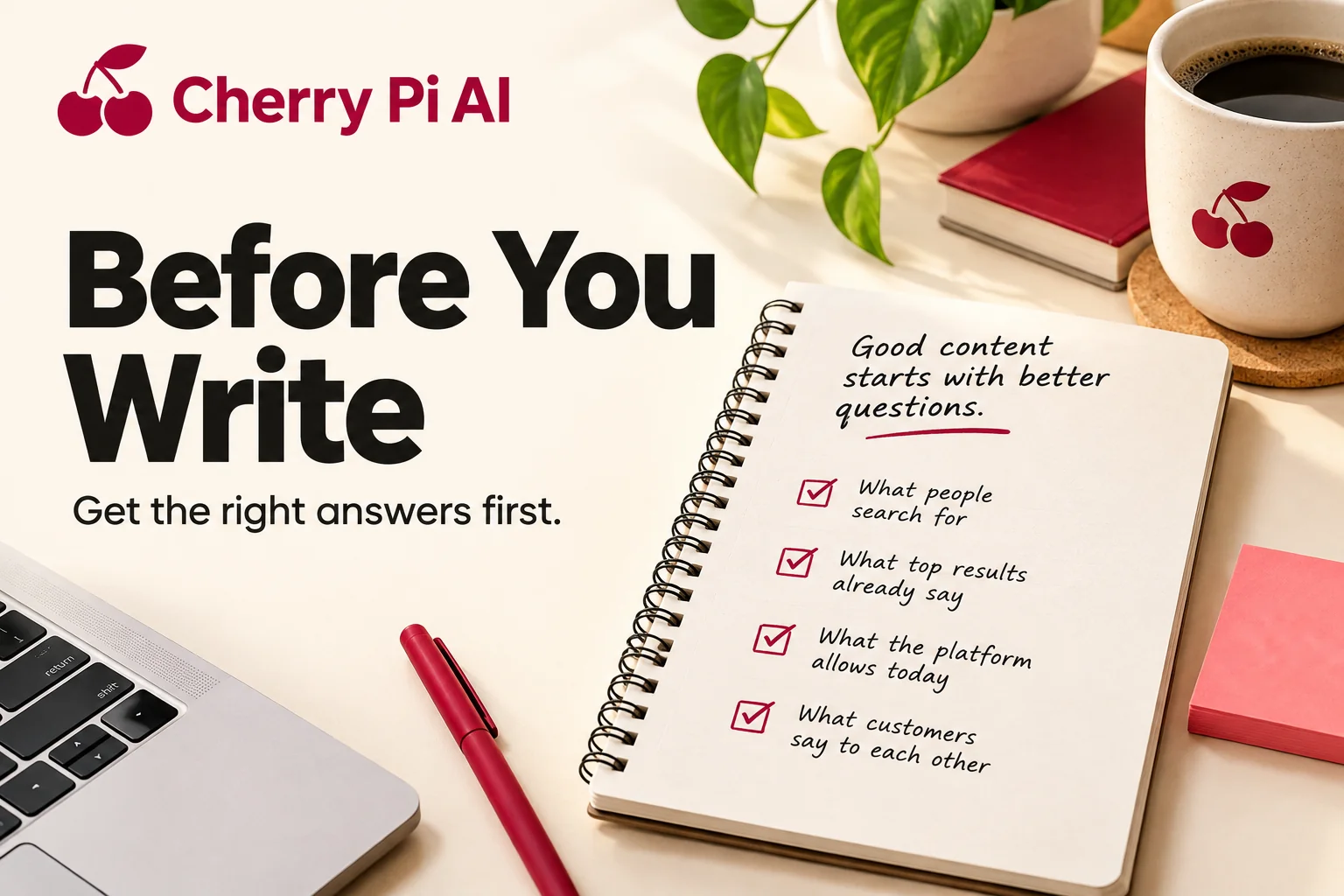
Before You Write
Four questions to answer before AI writes anything you'll publish, with a free place to find each answer.
Want help applying this to your business? Get in touch and tell me what you're about to publish.
The listing that started from nothing
In September a small manufacturer hired me to get their first product onto Amazon. They'd sold it in person for years, so the listing started from nothing: no reviews, no sales history and no copy. It would also sell at four to eight times the price of page one, like for like, so every line had to earn the difference with something true.
AI could have written that listing in about a minute. In my experience, though, AI writes from what it's given, and given nothing it mostly repeats what's already out there. So before it wrote a word, I wanted four answers, each from its own source: what shoppers type, what page one says, what Amazon allows today and what buyers say once they own one.
Every answer changed the listing, and none of them could stand in for another. My own first keyword report even told me to copy the leaders' long titles. Amazon had cut titles from 200 characters to 75 on July 27, 2026, and page one was still full of long ones because Amazon rewrites old listings gradually. Only Amazon's own rules page said so.
Google asks for a human check on websites too. Its guidance on AI-generated content, updated October 1, 2026, says "It is critical to manually factcheck and review all AI-generated content for accuracy and trustworthiness before publishing." I check every draft after it's written. The worksheet is the step before that, so the draft has something true and specific to say before anyone checks it.
So I turned the four questions into this worksheet. It works for anything AI writes that you'll publish: a product listing, a service page, a blog post or an About page.
The AI on that project ran every search I asked for. It never suggested reading what buyers say to each other. That question was my idea, and it changed the listing more than any other.
AI fills a gap with a confident guess
Two research reports I ran for that listing came back with things that weren't true. One said a brand without Amazon's Brand Registry has to list as "Generic." Amazon's own Brand Name policy calls that a violation. The other offered an example product claim with a precise distance in it, and the distance was made up. Both read exactly like the true parts around them.
Write down where every answer came from. When an AI's answer and the platform's own page disagree, the platform's page wins, and you'll only spot the disagreement if you looked.
The worksheet
Fill in one sheet for each page you're writing. Answer questions 1 to 4 from four different places, because in my experience each one finds something the others miss.
What I'm writing: [a product listing, a service page or a blog post]
Who it's for: [the customer, in one line]

1. What do people search for?
    The words they type: ____________
    A name for it I hadn't heard: ____________
    Where I looked: ____________

2. What do the top results already say?
    How many I read: ____________
    What they all say: ____________
    What none of them say: ____________

3. What does the platform allow today?
    The rules page I read: ____________
    Limits and banned words: ____________
    Checked on: ____________

4. What do customers say to each other?
    Their biggest complaint: ____________
    A question nobody answers for them: ____________
    Where I found it: ____________

Questions only the owner can answer: [four at most, the one I can't write without goes first]
    1. ____________
    2. ____________
    3. ____________
    4. ____________

Left out on purpose, and why: ____________

Ready to write when: questions 1 to 4 each have an answer from their own source.
Ready to publish when: the owner has answered every question above and the draft keeps to every limit in question 3.
Where to find each answer for free
Every question has a free place to start. The right-hand column is what each one turned up on the listing.
| Question | Where to look | What it changed on the listing |
|---|---|---|
| 1. What do people search for? | Start typing your topic into Google or Amazon and write down every suggestion. If you have a website, Google Search Console is free and shows the searches already bringing people to you. Write down the words they use, even when you'd call it something else. | Buyers had a second name for the product that nobody on the project had heard of, me included. It went into the listing. |
| 2. What do the top results already say? | Search it yourself and open every result on page one, not just the top one. If a tool or an AI did the search, ask how many results it actually read. | My first pass read 10 results, because a tool's default setting cut the list without a warning. The full search came back with 124. Checking all 18 big sellers added six search terms the draft had missed. |
| 3. What does the platform allow today? | The platform's own rules pages, never a competitor's page or someone's summary. For Amazon that's the Seller Central help pages. For a website it's Google Search Central. Write down the date you checked. | The 75-character title limit, from Amazon's own announcement. The title now sits at 74. Several words page one uses freely stayed out of every field, because Amazon bans or regulates them. |
| 4. What do customers say to each other? | Search Google for your topic plus the word reddit. Read the comments under how-to videos and your competitors' reviews. On Amazon, the "Customers say" box on a product page is basically Amazon's own summary of all its reviews, with counts. | The category's biggest complaint was the product coming loose: 247 mentions in the two best sellers' summaries, 119 of them negative. No keyword list had it. It moved the line about how this one attaches up to bullet three. |
The questions only the owner can answer
Some facts no search will find. Whatever the research couldn't confirm becomes a question for the owner, and if you're the owner, it's a question for you. Left alone, AI fills each of those gaps with a guess that sounds right.
I keep it to four questions at most, with the one I can't write without first. On the listing that was "Is every part made in the US?" The title depended on it, because the FTC's Made in USA standard only allows a plain "Made in USA" when all or virtually all of the product is made here, parts included. The owner answered all four the next day, and every answer changed or confirmed a line of the listing.
One answer in the first round changed three fields at once. The draft described one version of the product as if it were every version, and the owner's reply showed that some packs are made differently. So add one more to your list: is every unit the same?
The owner answered three questions within hours and four more the next day. Asking before the sign-off means the version the owner signs off on is already finished.
Handing the sheet to the AI
Once questions 1 to 4 are filled in, paste the sheet into ChatGPT or Claude with this prompt.
Write [what you're writing] for [the business].

Use only the facts on the worksheet below.
Use the customers' words from question 1.
Answer the complaint and the question from question 4 wherever the page can.
Keep to every limit and banned word from question 3.
Leave out everything on the "Left out on purpose" line.
If you need a fact that isn't on the worksheet, don't guess. List it at the end as a question for the owner.

[paste the filled-in worksheet here]
The line about not guessing does the most work. Without it, the AI fills a gap with something that sounds right. With it, you get a list of questions instead, and those go to the owner. On the listing, the owner questions came from the same kind of step: anything the research couldn't confirm became a question.
Step by step
- Fill in questions 1 to 4, each from its own source, and note where every answer came from.
- Hand the sheet to the AI with the prompt.
- Send the owner four questions at most: the ones the AI listed and anything you couldn't confirm, with the one you can't write without first.
- Put each answer straight into the draft, the day it arrives.
- Check the draft against every limit in question 3 before it goes anywhere.
- Keep the "Left out on purpose" line with the page, so nobody adds those words back in six months.

About Andrew Voskov
Andrew Voskov is the founder of Cherry Pi AI. He spent twenty years running online businesses before AI, including two Amazon brands. This worksheet came out of researching a small manufacturer's first Amazon listing in September and October 2026, where every one of the four questions changed the copy.
If you're about to have AI write something you'll publish and want a second pair of eyes on the research, get in touch. Tell me what it is and where it's going.
Found this useful? Follow along on LinkedIn. I post free systems and breakdowns every week.
Follow Andrew on LinkedIn